

There is a particular kind of fatigue that comes from modern music streaming. You open an app, and before you have chosen a single song, the software has already chosen for you. A “Made For You” mix greets you. A row of algorithmically generated playlists scrolls past. The home screen is a slot machine of recommendations, each one tuned by a recommendation engine that has quietly concluded it knows your taste better than you do. For many listeners this is a convenience, and a real one. For others it has become a low-grade unease: the sense that the music we hear is increasingly the music a system has decided we should hear, and that the artists who reach us are the ones a system has decided to promote.
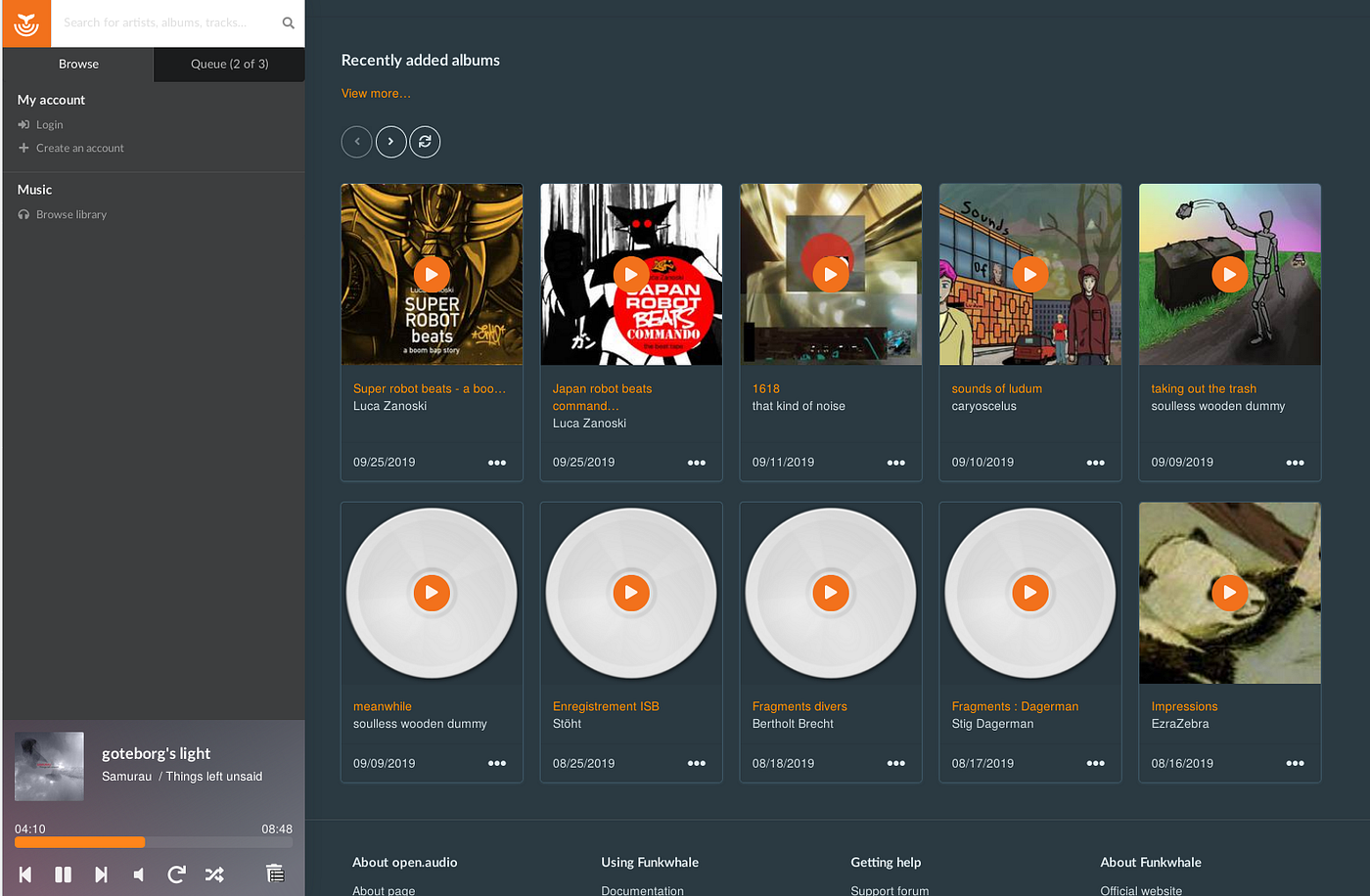
Funkwhale is one answer to that unease. It is a free, open-source, self-hosted audio platform built on the same federation technology that powers Mastodon and the wider Fediverse. It lets people host their own music libraries, publish channels and podcasts, and connect their servers together so that content flows across a network of independently operated “pods” rather than through a single corporate hub. There is no central catalog, no house recommendation algorithm ranking artists, no advertising engine, and — according to the project — no third-party analytics or tracking.
This article looks at what Funkwhale actually is and how it works, both technically and socially. It also takes seriously the phrase in its title. “Music without algorithm censorship” is a compelling banner, but it deserves scrutiny rather than cheerleading. Decentralization changes who holds power over what you hear; it does not abolish power, and it does not abolish moderation. Understanding that nuance is the difference between a marketing slogan and a genuinely useful tool.
The Problem: Algorithmic Gatekeeping and the Homogenization of Taste
To understand why a project like Funkwhale exists, it helps to name the problem it responds to.
Mainstream streaming platforms are extraordinary pieces of engineering. They put tens of millions of tracks in your pocket, they work seamlessly across devices, and their recommendation systems are genuinely good at surfacing music you will probably enjoy. But the same machinery that makes them convenient also concentrates enormous influence in a small number of privately owned systems.
Consider what an algorithmic feed actually does. It ranks. Every time a home screen decides which playlist to show first, which artist to feature, and which track to autoplay when the current one ends, it is exercising editorial power at a scale no radio programmer ever had. The ranking is optimized for metrics the platform cares about — engagement, retention, time spent listening, and increasingly the platform’s own margins. Those incentives are not neutral. They tend to reward music that keeps people passively streaming, that fits neatly into moods and background contexts, and that performs well early enough to trigger the flywheel of further promotion.
Several consequences follow. The first is homogenization. When millions of people are funneled through the same recommendation logic, tastes converge. Songs are engineered to hook a listener in the first few seconds because skip rates feed the algorithm. Playlists optimized for “focus” or “chill” flatten distinct artists into interchangeable sonic wallpaper. Critics have long worried that the streaming economy quietly nudges music toward a safe, frictionless middle.
The second consequence is opacity. The rules that decide which artists get surfaced are proprietary and constantly changing. An independent musician has little insight into why their track was or was not added to an influential playlist, and little recourse when the answer is simply “the model didn’t favor it.” This is where the loaded word censorship enters the conversation. Strictly speaking, most of what people call algorithmic censorship is not deletion or legal suppression of speech. It is deprioritization — being made invisible rather than being removed. But to an artist whose livelihood depends on discovery, the practical effect of never appearing in anyone’s recommendations can feel indistinguishable from being silenced. It is worth being precise here: genuine takedowns (for copyright, licensing disputes, or content-policy violations) do happen on major platforms, but the more pervasive dynamic is the quieter one of ranking and suppression by omission.
The third consequence is dependency. Artists do not own their relationship with their audience on these platforms. The listener belongs to the platform, not the musician. If the terms change, if the payout-per-stream drops, or if a track is pulled in a licensing dispute, the artist has no independent channel to fall back on. The audience they spent years building can be reshaped or removed by decisions made in a boardroom.
None of this makes centralized streaming evil. It makes it centralized — and centralization is precisely the property that decentralized alternatives set out to change.
What “Decentralized Streaming” and the Fediverse Mean
Decentralization is one of those words that gets used loosely, so it is worth grounding it.
A centralized service runs on infrastructure owned and controlled by a single organization. Spotify is Spotify. There is one company, one set of servers, one account system, one catalog, one set of rules. You are a user of that company’s product, and the company sets the terms.
A decentralized service, by contrast, is not one thing but many interoperating things. Instead of a single provider, there are many independent servers — in Funkwhale’s vocabulary, pods — each run by a different person, collective, or organization. Each pod has its own administrator, its own rules, its own community, and its own content. What makes them a network rather than a scatter of isolated islands is a shared protocol that lets them talk to one another.
That protocol, in Funkwhale’s case, is ActivityPub: an open, W3C-standardized specification for social networking that allows independent servers to exchange content and interactions. ActivityPub is the same standard that underpins Mastodon (a decentralized alternative to Twitter/X), PeerTube (decentralized video), Pixelfed (photos), and a growing constellation of other software. Collectively, this interconnected network of independently operated but interoperable servers is called the Fediverse — a portmanteau of “federation” and “universe.”
The key idea is federation. In a federated system, you sign up on one server, but you can follow, interact with, and receive content from users on other servers, as long as they all speak the same protocol. Your account lives on your chosen pod, but your reach extends across the network. It is closer to how email works — you can have an account at one provider and still write to someone at a completely different provider — than to how a walled-garden app works.
Because Funkwhale speaks ActivityPub, its ambitions extend beyond Funkwhale-to-Funkwhale connections. The project has increasingly framed its roadmap around being ActivityPub-first, so that a Funkwhale channel could, in principle, be followed and interacted with from other Fediverse software such as Mastodon. In its public plans for the 2.0 generation of the software, the project described wanting to let people follow users and see a stream of their listenings and favorites, and to present channel content across ActivityPub-compatible platforms rather than keeping it locked inside Funkwhale’s own ecosystem. A developer associated with the project also built a general-purpose ActivityPub and ActivityStreams library for Python to support cleaner federation. The direction of travel is toward a music service that behaves less like an app and more like a citizen of the open social web.
Decentralized streaming, then, does not mean “streaming with no infrastructure.” It means streaming where the infrastructure is plural, independently governed, and interoperable — where no single entity owns the whole network or dictates its terms.
A Short History of Funkwhale
Funkwhale did not start as a federation project at all. It began in 2015 as a personal endeavor by Agate Berriot, conceived as a self-hosted alternative to Grooveshark, the music-streaming service that shut down that same year after prolonged legal battles with the recording industry. The original goal was modest and concrete: a place to host and stream your own music collection on your own server, rather than depend on a service that could vanish.
The technology reflects that origin. The backend is written in Python using the Django framework; the frontend is a JavaScript application built with Vue.js; and the whole thing is released under the AGPL-3.0 license. The AGPL is a deliberate and meaningful choice. It is a strong copyleft license designed for networked software: anyone who runs a modified version of Funkwhale as a public service is obliged to make their modified source code available. In a domain that is explicitly about resisting proprietary lock-in, licensing the software so that it cannot easily be captured and closed off is not an afterthought — it is part of the point.
Federation arrived later. In 2018 the project added ActivityPub support, which enabled the exchange of music libraries between instances and transformed Funkwhale from a solo self-hosting tool into a genuinely networked one. Around the same period the internal model shifted: where libraries had once been managed at the level of the instance administrator, they became associated with individual user accounts, laying groundwork for a more social, multi-user design.
Governance evolved too. What began as one person’s project became, in June 2019, a French non-profit association called the Funkwhale Collective, moving stewardship from an individual to a collective body. The organizational arrangements have continued to shift over the years — including transitions in the legal and fiscal-hosting structures behind the project — but throughout, development has remained community-driven rather than commercially owned. Funkwhale has also received support from public-interest funders in the European open-technology ecosystem, including the NLnet Foundation, whose grant programs back projects that advance open standards and decentralization. (Because funding arrangements and organizational details change over time and are not always precisely documented in one authoritative place, these should be read as the broad shape of the project’s history rather than an audited record.)
The current generation of the software is the 2.x series, whose headline theme is deeper and more standards-compliant federation. That thematic choice tells you where the project’s heart is: not in chasing feature parity with commercial giants, but in making the open, interconnected vision work well.
How Funkwhale Works: The Technical Picture
At a technical level, Funkwhale is a server application you (or someone else) runs. A running instance is a pod. Understanding a few core concepts makes the whole system legible.
Pods
A pod is an installation of Funkwhale on a server, complete with its own web address, user accounts, storage, and administrator. Deployment is typically done with Docker Compose, and there is documentation for manual installation as well. For people who do not want to manage a server directly, managed-hosting options exist through providers in the self-hosting ecosystem, and the software is packaged for platforms like YunoHost that specialize in one-click self-hosting. Each pod is sovereign: its administrator sets registration rules, storage limits, moderation policy, and whether various features (such as open sign-ups or the Subsonic API) are enabled.
Libraries
Content in Funkwhale is organized into libraries. A library is a collection of audio — uploaded music files, for instance — with its own visibility settings. A library can be private to you, shared with specific people, or made public and federated across the network. This granularity is a defining feature. Rather than a single monolithic catalog, Funkwhale gives users individually controlled collections with per-library permissions, so you decide exactly who can see and stream what you host.
Channels
Channels are Funkwhale’s answer to the artist-and-audience relationship. A musician or podcaster can create a channel, publish releases or episodes to it, and let people subscribe. Subscribers can be notified of new content. Crucially, because channels are built to work over ActivityPub, a channel is not merely a folder on one server — it is a federated object that other pods (and, increasingly, other Fediverse software) can follow. This is the mechanism that lets an artist publish directly to an audience without an intermediary platform ranking them.
Podcasts
Funkwhale treats podcasts as a first-class use case, not a bolt-on. Channels can host podcast feeds, and the platform is designed to interoperate with standard podcast applications. This matters because podcasting has historically been one of the more genuinely open corners of digital audio — built on open RSS feeds — and Funkwhale extends that openness into a self-hosted, federated home for shows.
Federation between pods
When a library or channel is public, its metadata and content can be shared across pods through ActivityPub. A user on Pod A can discover, follow, and stream public content that physically lives on Pod B. Following a channel elsewhere creates a subscription relationship that carries new content to you. The network effect emerges from many pods choosing to federate their public content, producing a distributed library that no single administrator controls.
Subsonic API compatibility
One of Funkwhale’s most practically important features is its support for a subset of the Subsonic API. Subsonic is a long-established personal-media-server protocol, and a whole ecosystem of third-party mobile and desktop apps speaks it. By implementing part of that API, Funkwhale lets you use those existing Subsonic-compatible clients to stream your Funkwhale content, rather than being confined to the official web interface or app. To use it, a user generates a dedicated Subsonic password within Funkwhale. Notably — and this is a useful illustration of the pod-sovereignty principle — a pod administrator can choose to disable Subsonic access entirely. The feature is powerful, but it exists at the discretion of whoever runs your pod, and Funkwhale implements only a portion of the full Subsonic API, so not every client feature is guaranteed to work.
Privacy and permissions
The project positions itself explicitly against the surveillance-driven model of commercial streaming, stating that it runs with no third-party analytics, no tracking, and no ads. Combined with per-library visibility controls and per-pod configuration, the result is a system where the default posture is user control rather than data extraction. That said, “no tracking” is a property of the software’s design and the good faith of the pod you join — a claim about how Funkwhale is built, not a cryptographic guarantee about every server on the network.
The Social Picture: Joining or Running a Pod
The technical architecture only matters because of the social arrangement it enables, so it is worth walking through the two paths a person can take.
Joining an existing pod
The lowest-friction way in is to join a pod someone else already runs. You browse the list of public Funkwhale pods, find one whose rules and community feel right — some are general-purpose, others are themed around a genre, a language, or a community — and register an account, assuming that pod has open registrations. From there you can upload your own music into libraries, create a channel, subscribe to channels on your pod and on federated pods, and stream through the web player or a Subsonic-compatible app.
Choosing a pod is a meaningful decision in a way that choosing a Spotify account is not. Your pod’s administrator sets the rules you live under and performs the moderation that shapes your experience. In practice, picking a Fediverse home is a bit like picking a neighborhood: the building (the software) is the same everywhere, but the management and the neighbors differ.
Running your own pod
The more ambitious path is to run your own pod. This is where Funkwhale most fully delivers on the promise of ownership. You provision a server, install Funkwhale (commonly via Docker Compose), configure your domain, and set your own policies. You decide whether to allow public registration or keep it a private instance for you and a handful of friends. You control storage, so the practical size of your library is bounded by the disk you are willing to pay for. You are, in the fullest sense, the platform.
This path is not for everyone, and honesty requires saying so plainly. Running a pod means running a server: keeping the software updated, handling backups, managing storage costs, and — if you open registrations — taking on the real responsibilities of moderation and administration. Development proceeds at the pace of a volunteer-driven, community-funded project, which can mean slower iteration and rougher edges than a commercial product with a paid engineering team. The reward for that effort is genuine autonomy; the cost is genuine work.
Use Cases: Where Funkwhale Shines
Funkwhale is not trying to be Spotify, and its most compelling uses are the ones a commercial catalog service cannot easily serve.
Artists sharing directly with an audience. For an independent musician, Funkwhale offers something rare: a direct, unmediated channel to listeners. You publish to your channel; your subscribers receive it; no ranking model stands between you and the people who chose to follow you. You are not competing for placement in a proprietary playlist, and you are not at the mercy of a recommendation engine’s shifting priorities. For artists whose work is deliberately non-commercial, experimental, or niche — precisely the work that algorithmic optimization tends to bury — this direct relationship can matter enormously.
Communities and collectives. A record label, a music school, a radio collective, a group of friends, or a scene built around a particular genre can run a shared pod as a commons. The pod becomes a gathering place with its own culture and rules, federated with the wider network but governed locally. This community-scale model is native to the Fediverse and is arguably where it works best: small-to-medium communities that want their own space without building their own technology from scratch.
Creative Commons and freely licensed music. Funkwhale actively promotes freely licensed content, and this is one of its most natural fits. There is a large and growing world of music released under Creative Commons and other open licenses — music that is explicitly meant to be shared, remixed, and redistributed. Commercial platforms, organized around licensed major-label catalogs, are not built for this material. Funkwhale is. A pod can become a legitimate, well-organized home for CC-licensed music, letting listeners discover work that the mainstream economy has little incentive to surface, and letting artists share it in a manner fully consistent with the license.
Personal music ownership. At the simplest level, Funkwhale is an excellent way to own your listening. If you have a collection of files — purchased downloads, your own recordings, live sets, archival material — Funkwhale turns it into a private streaming service you control, accessible from a browser or a Subsonic app, without handing your library or your listening habits to a third party.
Strengths and Real Limitations
An honest appraisal has to hold both sides at once.
The strengths are substantial. Funkwhale gives you ownership of your library and your data. It runs without ads, tracking, or third-party analytics. Its open-source AGPL foundation means it cannot be quietly enclosed and taken proprietary. Its federated architecture means no single company can flip a switch and change the terms for everyone. It removes the house recommendation algorithm from the center of the experience, replacing “what the system decided to show you” with “what you and the people you follow chose.” And it integrates with an existing ecosystem of Subsonic clients and podcast apps rather than trapping you in one interface.
The limitations are equally real, and pretending otherwise would do the reader a disservice.
First and most obviously, there is no licensed commercial catalog. Funkwhale streams only content that users upload or that federates in from other pods. You will not find the latest major-label release waiting for you the way you would on Spotify. For listeners whose primary need is instant access to the entire commercial canon, Funkwhale is simply not a substitute. It is a different kind of tool for a different kind of listening.
Second, there is a technical and effort barrier. Getting the full benefit — especially running your own pod — requires comfort with servers, or at least a willingness to lean on managed hosting. This is meaningfully harder than downloading an app.
Third, discovery is a genuine tradeoff, not a pure win. Removing the recommendation algorithm removes both its harms and its conveniences. The friction of finding new music you would not have thought to search for is real, and a federated network of user-uploaded libraries does not replace it with an equally frictionless alternative. You gain agency; you lose some serendipity, or at least you have to work for it differently, through people and communities rather than a model.
Fourth, the network is smaller than the commercial giants, and the software advances at community pace. Federation’s value grows with participation, and a smaller network has fewer public libraries, fewer channels, and fewer people to follow. Polish and feature velocity trail well-funded commercial products.
Does Funkwhale Really Mean “Without Algorithm Censorship”? A Fair Reading
This is the claim that most deserves careful handling, because it is the one most easily oversold.
What Funkwhale genuinely removes is the central, proprietary, engagement-optimized recommendation algorithm as the organizing force of your listening. There is no house model ranking every artist and deciding, opaquely and network-wide, who gets discovered and who disappears. In that specific and important sense, the “algorithmic gatekeeping” problem described at the start of this article is structurally absent. No single entity holds the lever. That is a real difference, not a rhetorical one.
But “without algorithm censorship” should not be mistaken for “without moderation” or “without any gatekeeping at all.” Decentralization relocates power; it does not dissolve it. On Funkwhale, every pod has an administrator who sets rules and moderates. A pod owner can refuse to federate with another pod, can remove content that violates their policies, can decline registrations, and can disable features like the Subsonic API. Moderation, in other words, absolutely still exists — it has simply moved from a single global authority to many local ones. If your pod’s administrator removes something, that is, from your vantage point, a form of gatekeeping, even if it is nothing like an opaque global ranking model.
There is a reasonable case that this distributed arrangement is healthier than centralized control. When moderation is local and pluralistic, no one decision governs the whole network; if you dislike how one pod is run, you can join or start another, and the AGPL license guarantees the software itself stays open. Power that is distributed and exitable is different in kind from power that is centralized and inescapable. But it is still power, still exercised by human beings with their own values and blind spots, and it can still be used well or badly.
It is also worth resisting a conspiratorial framing of the original problem. Algorithmic curation on major platforms is driven far more by commercial incentives and the mechanics of engagement optimization than by any deliberate program of ideological suppression. Much of what feels like censorship is really the byproduct of ranking systems optimizing for metrics that have nothing to do with artistic merit. Funkwhale’s value proposition is strongest when stated in those honest terms: not that it rescues you from a shadowy censor, but that it removes the engagement-optimized ranking layer from the center of your musical life and hands the editorial decisions back to you and to communities of human scale.
How It Compares to Centralized Services
The clearest way to situate Funkwhale is as a fundamentally different product answering a different question.
Centralized services like Spotify answer the question “How do I get instant, frictionless access to essentially all commercial music, with smart recommendations, on any device?” They answer it superbly, and the price is dependency: your library, your audience relationships, your listening data, and the rules all belong to the provider, and a recommendation engine mediates much of what you hear.
Funkwhale answers a different question: “How do I own my listening and my library, publish directly to an audience without an intermediary ranking me, and participate in an open network no single company controls?” It answers that well, and the price is convenience and catalog: you supply the content, you may supply the infrastructure, and you trade some effortless discovery for autonomy.
These are not competitors so much as inhabitants of different worlds. Plenty of people will sensibly use both — a commercial service for the convenience of the mainstream catalog, and a Funkwhale pod for the music they own, the CC-licensed work they want to explore, the community they belong to, and the direct relationship they want with artists they care about.
Conclusion
Funkwhale is not going to dethrone the streaming giants, and it is not trying to. What it offers is something narrower and, for the right person, more valuable: a way to listen and to publish that is not organized around an engagement-optimizing recommendation engine owned by a single company. Built on ActivityPub and the open Fediverse, licensed under the strongly protective AGPL, and stewarded by a community rather than a corporation, it embodies a genuine alternative philosophy about who should hold power over music — many hands at human scale, rather than one hand at planetary scale.
The honest version of its promise is more interesting than the slogan. “Music without algorithm censorship” overstates the case if it is read as freedom from all gatekeeping; moderation persists at the pod level, and it should, because communities need it. But read accurately, the promise holds: Funkwhale removes the central, opaque, commercially tuned ranking layer that increasingly decides what listeners hear and which artists get found, and it replaces that single point of control with a plural, interoperable, exitable network where the editorial choices belong to you and to communities you can actually see and leave.
For independent artists seeking a direct line to their audience, for communities wanting a music commons of their own, for the vast and under-served world of Creative Commons music, and for listeners who would rather own their library than rent access to someone else’s, Funkwhale is a serious and thoughtfully built option. It asks more of you than a commercial app does — more effort, more choice, more responsibility. In return it offers something those apps structurally cannot: music on terms you help set, in a network no one owns. In an era of algorithmic homogenization, that is not a small thing to offer.
Sources consulted for this article include the official Funkwhale website and documentation (funkwhale.audio and docs.funkwhale.audio), the Funkwhale project blog’s writing on federation and the 2.0 direction, and secondary reference and review material on Funkwhale’s history, licensing, technology stack, and features. Details of organizational structure and funding change over time and should be treated as the broad shape of the project rather than an audited record.