


There is a particular kind of fatigue that sets in after years of algorithmic listening. You open the app, and it already knows what it wants you to hear. The autoplay queue slides seamlessly from one track into the next, each one a fractional variation on the last, until you look up an hour later and realize you cannot name a single thing you listened to. The music was fine. It was always fine. That is the problem. The machine had optimized fine so thoroughly that it had sanded away every edge that might have made a song stick, surprised you, or asked something of you. You did not choose any of it, and so none of it chose you back.
This article is about the people and projects building an alternative to that experience — a quietly growing constellation of niche services, self-hosted tools, community radio stations, and small apps that share a single conviction: that listening should be an act you perform rather than a feed you receive. Some of these tools are well-documented and widely used. Others, like the two named in the title, are genuinely obscure, and I want to be honest throughout about where the solid ground ends and the speculation begins. But taken together they sketch the shape of a movement — call it algorithm-free listening, or intentional listening, or simply the human-scale internet — that is worth understanding, because it says something about what we lost when we handed our attention to recommendation engines, and what it might take to get it back.
Two Small Names in a Big Argument
Let me start with the two services in the title, because they are instructive precisely for how different they turn out to be from one another, and how easy it would be to misremember or conflate them.
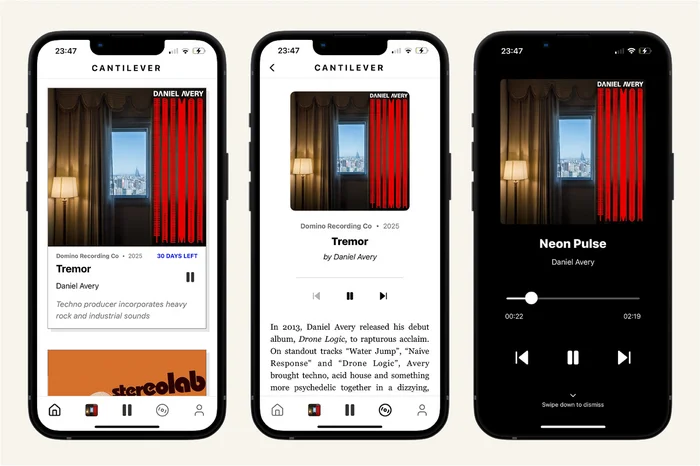
Cantilever is a real and recent arrival. It is a curated music streaming app founded by Aaron Skates, a London-based music writer with a background in independent labels, who developed the concept from around 2022 before launching publicly in October 2025. The pitch that has followed Cantilever around — and that Skates himself has leaned into — is that it is “the MUBI of music streaming,” or, as he has elaborated, something “like MUBI, Criterion, or the BFI Player, but for music.” That comparison is the whole thesis in miniature. Where Spotify offers you a bottomless, undifferentiated ocean of roughly a hundred million tracks and an algorithm to navigate it, MUBI offers a small, hand-picked rotation of films, each one chosen by a human being who wants to tell you why it matters. Cantilever applies that logic to records.
In practice this means Cantilever runs an intentionally limited catalog. A rotating selection of albums is available at any given time; new releases join every few days, and older titles cycle off after roughly a month. Each album is paired with editorial context — a journalist’s article, an artist interview, a piece of writing that frames the listen rather than leaving you to drift. Scarcity is the design principle. Because you cannot have everything, you are nudged toward actually finishing the record in front of you, sitting with it, returning to it before it disappears. This is the opposite of the streaming-era anxiety that there is always something better one tap away.
Cantilever’s economics are as deliberate as its curation. The service charges a modest subscription — around six US dollars a month, with a free trial — and, crucially, it uses a user-centric royalty model rather than the industry-standard pro-rata pool. Under the pro-rata system that Spotify and most major platforms use, all subscriber money is poured into one pot and divided according to total stream share, which structurally favors the biggest artists regardless of what any individual actually played. Under Cantilever’s user-centric model, your subscription is directed toward the specific artists you listened to. It is a small idea with large moral consequences, and it echoes similar experiments such as SoundCloud’s fan-powered royalties and Tidal’s alternative payout tiers.
The company closed a pre-seed funding round of a quarter of a million pounds from around twenty investors, and the investor list is the tell: it is dominated by independent labels — Domino, Ninja Tune, Sub Pop, !K7, Partisan, and the Secretly Group among them. These are the tastemaker labels of the last three decades of independent music, and their backing signals that Cantilever is positioned less as a mass-market Spotify competitor than as a boutique home for the kind of music that algorithmic platforms tend to bury. Whether it succeeds commercially is an open question — the streaming graveyard is full of well-intentioned alternatives — but as a statement of values it is unusually coherent.
Lissen is a different animal entirely, and here the title’s pairing is almost a provocation, because the two services barely occupy the same category. Lissen is not a music streaming service at all. It is a minimalist, open-source Android application that acts as a client for Audiobookshelf, the popular self-hosted server software for audiobooks and podcasts. Developed by a maintainer working under the handle GrakovNe, released under the permissive MIT license and written almost entirely in Kotlin, Lissen is available both on Google Play and through F-Droid, the free-and-open-source Android app repository. It offers cloud synchronization of your listening position across devices, direct streaming from your own server, offline downloads, and progress tracking synced back to the server — all wrapped in a deliberately spare interface.
What makes Lissen relevant to this discussion is its stated philosophy. The developer is explicit that Lissen “is not a clone of the official Audiobookshelf app” and does not aim for feature parity. It chooses, instead, to do less. It is a client for a library you already own and control — a front end onto files sitting on a server in your own home or on hardware you rent, organized the way you organized them, with no discovery feed, no recommendation engine, no advertising, and nothing trying to extend your session. You point it at your own collection and it gets out of the way. In that sense Lissen is not really about audiobooks specifically; it is a small, clean example of a much larger idea, which is that the software you listen through should serve your intentions rather than a platform’s growth metrics.
So the two title services turn out to be a music app and an audiobook client, a hosted boutique service and a self-hosted client, a curation play and a minimalism play. They do not compete; they barely overlap. What unites them is a posture — a refusal of the algorithmic default — and it is that posture, more than any single app, that is worth examining. Before I widen the lens, one honesty note: “Cantilever” and “Lissen” are both common-enough words that a casual search will surface unrelated products, projects, and companies using the same names in architecture, engineering, and other software domains. The Cantilever I have described is Aaron Skates’ music service; the Lissen I have described is the Audiobookshelf client by GrakovNe. If you go looking, verify you have found the right one, because the names are not unique and the surrounding noise is real.
What Exactly Are We Resisting?
To understand why anyone would build these things, it helps to be precise about what algorithmic listening actually does, because the critique is often waved at rather than stated.
The recommendation engine is not neutral. It is optimized, and the thing it is optimized for is engagement — time on platform, sessions extended, skips avoided. Those are the metrics that keep subscribers subscribing and advertisers advertising. The consequence, documented and complained about for years now, is that the algorithm tends to narrow rather than expand your listening. It has learned, correctly, that the safest way to keep you playing is to give you more of what you already tolerate. Novelty is a risk; the familiar-but-not-identical is the sweet spot. Over time this produces the strange flattening effect that so many listeners describe: a personalized radio that plays an endless middle, music engineered to be inoffensive enough never to make you reach for your phone.
There is a darker layer to the critique as well. Reporting and commentary over the past couple of years have described the proliferation of so-called “ghost artists” and AI-generated or library-music tracks quietly slotted into mood and ambient playlists on major platforms — background music that costs the platform little or nothing in royalties, filling the spaces where a human artist’s work used to sit. Whatever the exact scale, the incentive is real: if the goal is cheap, frictionless, engagement-optimized audio, then music with an author, a point of view, and a royalty claim is a cost to be minimized. The endpoint of that logic is a feed that is technically music and functionally wallpaper.
Writing in the culture magazine 032c, Shane Anderson framed this as a question of taste versus “AI slop,” using NTS Radio as his central example. His argument is worth summarizing because it captures the philosophical core of the whole algorithm-free movement. Algorithmic systems, Anderson contends, inevitably flatten experimental and difficult music into predictable patterns optimized for continued listening, because that is what they are built to do. Human curation does something categorically different. Taste, in his account, is not data analysis; it develops through lived experience and emotional engagement, and it cannot be reverse-engineered from your skip history. When a DJ is handed a studio and told to do whatever they want — which, Anderson notes, is exactly the freedom NTS extends and exactly the freedom a narrow, ad-optimized broadcast cannot afford — the result is genuine discovery and, more than that, community. Strangers in Seoul, São Paulo, and Manchester find each other through a shared aesthetic. Crucially, he reframes taste not as Bourdieu-style class gatekeeping but as a form of intimacy: a way for people to connect through what they love. That reframing matters, because the easiest dismissal of curation is that it is snobbery. Anderson’s answer is that curation, done well, is generosity.
That is the emotional engine behind everything in this article. The algorithm optimizes for the average of your past behavior. A human curator, a self-directed library, or a live radio host optimizes for something they believe you should hear — and in that gap between what you would have chosen and what someone hoped you might love, discovery actually happens.
The Well-Documented Middle of the Movement
If Cantilever and Lissen are the obscure edge of algorithm-free listening, the middle of the movement is far more established, and it is worth mapping in some detail, because these are the tools most readers can actually pick up today.
Self-hosting: Navidrome, Subsonic, and Jellyfin
The most complete way to escape the algorithm is to own the library. This is the world of the self-hosted music server, and its flagship in 2026 is Navidrome — a lightweight, open-source music server that you install on your own hardware or a cheap cloud instance, point at a folder of your own audio files, and stream to any device. Navidrome implements the long-standing Subsonic API, which means it is not a walled garden but a protocol: a whole ecosystem of third-party client apps for phones, desktops, and even cars can connect to your server. Jellyfin, the broader open-source media server, offers a similar music capability for people who also want to self-host video, and the perennial 2026 comparison between the two comes down to whether you want a dedicated, music-first tool (Navidrome) or an everything-in-one-place media hub (Jellyfin).
The tech press has spent the last couple of years documenting a small wave of people migrating from Spotify to Navidrome, and the language they use is revealing. The recurring phrase is that their music “finally feels like mine again.” What they are describing is ownership in both the literal and the emotional sense. The files are theirs; they do not vanish when a licensing deal lapses. The organization is theirs; the folder structure, the tags, the playlists reflect a real human relationship with a collection rather than a platform’s model of a user. And there is no recommendation feed at all — you play what you deliberately added, which sounds like a limitation until you realize that the absence of infinite choice is the entire point. A self-hosted library is finite the way a record shelf is finite, and a finite library invites you to actually know it.
The trade-off is real and should not be soft-pedaled. Self-hosting requires that you acquire the music in the first place, maintain a server, handle backups, and accept that you are now a very small systems administrator. This is not for everyone, and pretending otherwise is how enthusiast movements alienate normal people. But the barrier has fallen dramatically — one-click deployment templates on hosting platforms now stand up a Navidrome instance in minutes — and for a certain kind of listener the maintenance is not a cost but a feature, a form of tending that deepens the relationship with the music.
Buying music: Bandcamp
The single most important algorithm-free institution in modern music is arguably Bandcamp, the online store and platform where artists sell music directly to fans. Bandcamp is not a recommendation engine and has never really tried to be one. It is a shop and a set of artist pages, and its discovery mechanisms are deliberately human: editorial writing through Bandcamp Daily, the tastes of the artists and labels you already follow, the fans whose collections are public, and the simple act of following a thread from one release to the next. When you buy on Bandcamp, a large majority of the money goes to the artist, and you receive an actual downloadable file that you own — which, not coincidentally, is exactly the kind of file you would then load into your Navidrome server. Bandcamp and self-hosting are natural companions: buy the record, own the record, host the record, listen on your terms.
Bandcamp’s ownership history has been turbulent in recent years, passing through corporate hands, and that instability is itself a lesson about how fragile these human-scale institutions can be when they sit inside larger businesses. But the model it proved — direct sales, real ownership, human curation, artists paid fairly — remains the north star for almost everyone else in this space.
Live human radio: NTS, community stations, and internet radio
Then there is radio, which turns out to be the oldest algorithm-free technology and, in 2026, one of the most vital. NTS Radio, the London-founded online station, has become the emblem of a broader revival that some have called a golden age of internet radio. The model is simple and ancient: a human being, live, plays you records and tells you about them. NTS extends near-total freedom to its DJs, and that freedom is precisely what produces the sense of discovery and community that Anderson wrote about. You cannot predict an NTS show, because a person made it, and a person is allowed to be strange.
Around NTS sits a whole ecosystem — station after station of specialist, community, and pirate-descended online radio, each a small world with its own hosts and obsessions. And beneath all of it is the sheer, sprawling infrastructure of the world’s actual broadcast radio, made newly explorable by Radio Garden, the app and website that renders thousands of live local stations as glowing dots on a spinnable globe. Radio Garden is a wonderful antidote to the streaming bubble precisely because it has no idea who you are and does not care. You spin the planet, drop onto a station in Lagos or Reykjavik or a small town in Brazil, and hear whatever the people there are hearing right now. It is discovery without personalization — the exact opposite of the algorithm’s premise that the best thing to play you is a reflection of yourself. Sometimes the best thing to play you is a window into somebody else.
Tracking and talking about music: Musicboard and the newsletter renaissance
Discovery is social, and a cluster of tools has grown up to support human, rather than algorithmic, social discovery. Musicboard and similar services function as a kind of Letterboxd for music — places to log, rate, review, and list albums, and to follow other people whose taste you trust. The mechanism of discovery here is not a model trained on your behavior; it is a person you have chosen to follow because their reviews resonate. That is a fundamentally different epistemology of recommendation: you are not being profiled, you are being befriended.
Running parallel is the renaissance of the music newsletter. A large and growing number of critics, DJs, and obsessives now publish regular curated dispatches — new releases, deep cuts, thematic mixes, essays — delivered to an inbox rather than served by a feed. The newsletter is an almost defiantly old-fashioned format, and that is the appeal: it arrives on a schedule, it ends, it was written by one identifiable person with a name and a point of view, and it asks you to read before you listen. It reintroduces friction, and friction, in this world, is a synonym for attention.
The Philosophy: Intention as the Point
Step back from the specific tools and a common philosophy comes into focus. What all of these projects share is not a technology or a business model — they range from for-profit apps to open-source software to volunteer radio — but a stance toward the listener’s agency. In each case, the human is meant to do something: choose the record, build the library, tune to the station, follow the curator, read the newsletter. The friction is not a bug that better engineering would remove. It is the mechanism by which listening becomes intentional, and intention is what converts consumption into experience.
This is worth dwelling on because it inverts a decade of product orthodoxy. The reigning assumption of the streaming era was that friction is always bad — that the ideal music experience is one in which you never have to decide anything, where the perfect next song simply appears. Measured by engagement, that assumption is correct; frictionless feeds keep people listening longer. But engagement and satisfaction turn out to be different things, and a great many people have discovered, on the far side of a decade of frictionless listening, that they cannot remember most of what they heard and no longer feel any relationship to it. The algorithm optimized away the very effort that made music mean something.
The algorithm-free movement is a wager that effort is where the meaning lives. When you deliberately place a record on a finite service like Cantilever before it rotates away, you are more likely to actually hear it. When you build a Navidrome library, you develop the intimate knowledge of a collection that no infinite catalog can produce. When you tune to a live human on NTS, you accept the gift of another person’s taste and, through it, join a small community of strangers who accepted the same gift. When you point Lissen at your own audiobook server, you are listening to a library you assembled, with nothing between you and it. In every case the listener is restored to the center of the act. The software serves the intention rather than manufacturing it.
There is an ethical dimension too, running underneath the aesthetic one. Cantilever’s user-centric royalties, Bandcamp’s direct-to-artist sales, the open-source and non-commercial nature of Navidrome, Lissen, Jellyfin, and community radio — these are all, in different ways, attempts to build listening systems that are not extractive. The algorithmic platform’s business model requires that your attention be captured and monetized, which is why it must optimize for engagement even at the cost of your satisfaction and the artist’s livelihood. The tools in this article, whatever their individual flaws, are trying to route value differently: toward the artist, toward the listener’s genuine experience, toward the commons. That alignment of aesthetics and ethics is not accidental. The same logic that flattens your listening into wallpaper is the logic that underpays the people who made the music. To resist one is, usually, to resist the other.
Honesty About the Edges
I want to be candid about the limits of everything I have described, because the failure mode of writing like this is a kind of romantic overstatement that does the movement no favors.
First, on the specific services. Cantilever is real but young, launched in late 2025, and there is no guarantee it survives; boutique streaming services have a poor mortality record, and a limited catalog is a hard sell in a market conditioned to expect everything. Lissen is real, actively developed, and genuinely useful, but it is a niche client for a niche self-hosting workflow used by a small community of technically comfortable people; its several hundred GitHub stars are a fair measure of a small, healthy project rather than a mass phenomenon. I have described both from their own documentation and from press coverage, and I have flagged that their names are shared with unrelated products. I have not invented features for either, and where the picture is thin, that thinness is the honest picture.
Second, on the movement as a whole. Algorithm-free listening asks more of the listener than algorithmic listening does, and most people, most of the time, do not want to be asked. That is not a moral failing; it is a reasonable response to busy lives. Self-hosting demands technical effort and up-front acquisition of music. Curated services demand that you accept someone else’s limits. Radio demands that you surrender control of what plays next. Newsletters and tracking apps demand that you read and write and pay attention. These are real costs, and the algorithmic platforms exist and dominate because, for a great many people, the frictionless default is genuinely preferable. It would be dishonest to pretend the whole world is quietly waiting to abandon Spotify. It is not.
And third, there is a risk of turning taste into a new snobbery — of treating the deliberate cultivation of a self-hosted library or a curated feed as a badge of superiority over the poor souls on the algorithm. Anderson’s reframing is the necessary corrective here: the point of curation is intimacy and generosity, not hierarchy. The value of algorithm-free listening is not that it makes you a more sophisticated person. It is that it restores a relationship — between you and the music, and between you and the other humans who love it — that the recommendation engine, by its nature, cannot provide.
Conclusion: Choosing to Choose
The through-line of this whole quiet movement is a single, almost embarrassingly simple idea: that it is better to choose your listening than to receive it. Cantilever chooses a small catalog and pairs it with human writing. Lissen chooses to do less, and to point you at a library you already own. Navidrome and its Subsonic kin let you own the whole thing outright. Bandcamp lets you buy it and pay the artist. NTS and Radio Garden hand you back to living human voices and living broadcast towers. Musicboard and the newsletter writers let you find music through people rather than profiles. None of these is going to dethrone the algorithmic giants, and none of them is trying to. They are building something smaller and, on their own terms, more durable: a human-scale way of listening, for the people who have noticed that the frictionless feed left them with everything and nothing at once.
What they are really offering is not better technology. It is the return of the listener as an active party — someone who decides, who tends a collection, who follows a curator, who accepts the gift of another person’s taste and, in accepting it, joins a community. The algorithm can predict what you will tolerate. It cannot give you the thing you did not know to ask for, delivered by someone who wanted you to have it. That remains a human capacity, and the whole point of Cantilever, Lissen, and the rest of these niche and lesser-known services is to defend the small spaces where it still lives. In an era racing to automate taste out of existence, choosing to choose is starting to look less like nostalgia and more like the most quietly radical thing a listener can do.
Sources consulted include coverage of Cantilever from Music Business Worldwide, Record of the Day, and Cantilever’s own materials; the Lissen project on GitHub, F-Droid, and lissenapp.org; Shane Anderson’s essay on NTS Radio and taste in 032c magazine; reporting on Navidrome and self-hosted music servers from How-To Geek, XDA Developers, and JellyWatch; and coverage of Radio Garden and human music curation from Android Police, Splice, and Ones to Watch. Readers are encouraged to verify the specific “Cantilever” and “Lissen” described here, as both names are shared with unrelated products.